Mathematics
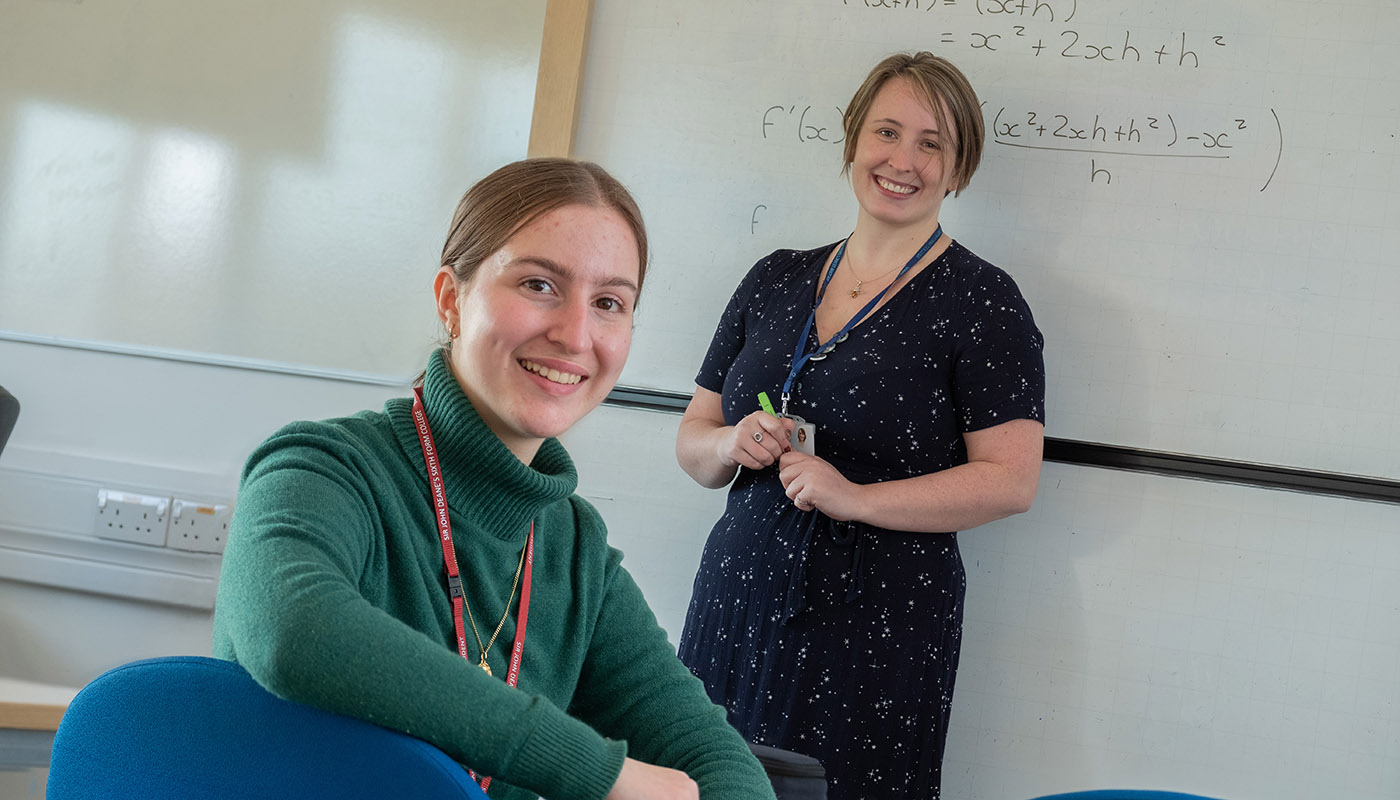
The Mathematics A level has two-thirds of content looking at pure mathematics, one-sixth looking at mechanics and one-sixth looking at statistics. Students will sit three papers at the end of their second year, each lasting for two hours.
Please be assured, the step up from GCSE to A level is not as steep as some people would have you believe, and we within the Maths department will make sure you have the support and guidance necessary to be successful with this transition.
As part of our commitment to ensuring students enjoy the challenges that studying mathematics brings, we arrange a number of activities throughout the year to enrich their experience.
These include sessions looking at decision mathematics, problem solving, financial mathematics and Maths Society where students look at mathematical content beyond the specification.
Students will also have the opportunity to enter competitions such as the Senior Maths Challenge and are also supported with preparing for a number of examinations that are required for university entry, such as STEP, MAT and TMUA.
Studying Mathematics is challenging, rewarding and stimulating and helps to develop the problem solving and reasoning skills that are so highly valued by employers.
There is an increasing demand (and pay) from universities and employers with maths skills and there are an increasing number of careers using mathematics explicitly. These include: logistics (shipping Amazon orders efficiently), marketing, science, engineering, technology, financial services, game design and statistics (including analysing ‘Big Data’).
Pure Mathematics – Exam Paper – 33.3% of marks
Pure Mathematics – 33.3% of marks
Mechanics and Statistics – 33.3% of marks
Summary
Pure Mathematics
Proof; Algebra and Functions; Coordinate Geometry; Sequences and Series; Trigonometry; Exponentials and Logarithms; Differentiation; Integration; Numerical Methods
Mechanics
Vectors; Quantities and Units in Mechanics; Kinematics; Forces; Newton’s Laws; Moments
Statistics
Statistical Sampling; Data presentation and Interpretation; Probability; Statistical Distributions; Hypothesis Testing
Students need to be confident in applying Higher Level GCSE techniques, in particular:
• Manipulating surds and indices.
• Solving linear equations.
• Solving quadratic equations: by factorising, using the formula and completing the square.
• Solving simultaneous equations by elimination and substitution.
Students should review these topics and practice questions on them using GCSE revision guides/the internet.
Students will also need to purchase a CASIO fx-991 CW (ClassWiz) scientific calculator. Other calculators are unfortunately not suitable. This is a new calculator designed for the new specification and includes statistical functions that are not present on other scientific calculators.
Study Level
A Level
Exam Board
Edexcel
Contact Details
Mike Griffiths
Head of Department
griffiths_m@sjd.ac.uk