Music
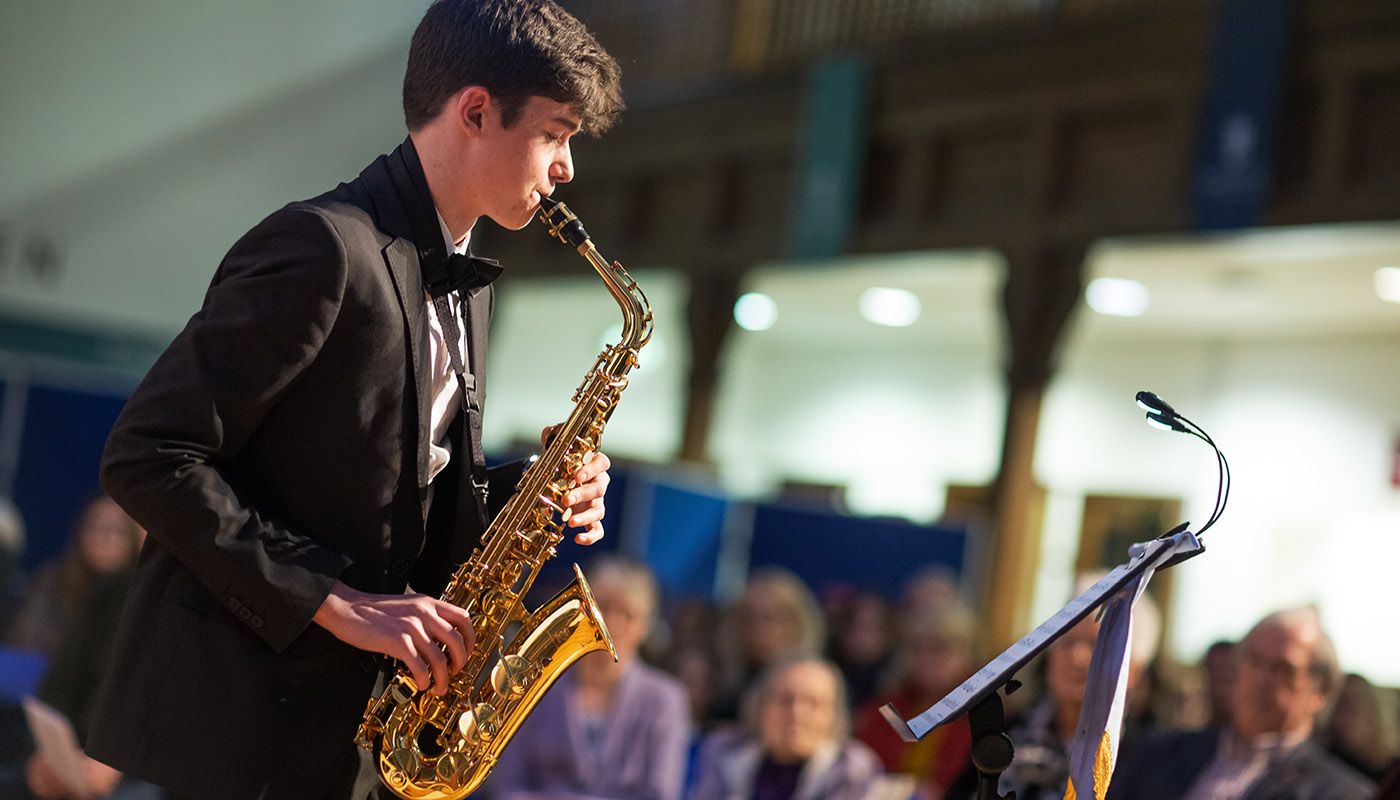
Studying A level music will enhance your performance and creative composition skills and develop your understanding and appreciation of a wide variety of musical styles and genres. These will include Vocal and Instrumental Music, Music for Film, Popular Music and Jazz, Fusions and New Directions. Creative composition tasks will ultimately lead towards the compilation of a small portfolio of original work, and the development of practical performance skills will result in a showcase recital at the end of the course.
Classroom activities are necessarily varied. It is very important that wherever possible, new concepts and ideas are explored practically as well as theoretically, in order to enhance understanding.
Music students can enjoy some of the best facilities available with dedicated practice rooms, a recital room, a range of musical instruments, recording studios and the latest computer technology.
The concert band, choir and Big Band rehearse weekly and perform regularly. There are also opportunities for smaller chamber ensembles and groups to rehearse together. It is hoped that music students will contribute fully towards the extra-curricular musical activities available, both as performers and even possibly, as directors! Indeed, over the past two years students have led a brass ensemble; saxophone group and folk group, all of which have then performed at the main College concerts and prestigious venues across Cheshire.
Music is an incredibly diverse subject and allows you to develop a wide variety of highly marketable skills that will be of use in other subjects, as well as in Higher Education and eventual employment. A number of past A level Music students have gone on to gain coveted places at specialist Music Colleges, Conservatoires and Oxbridge, as well as highly competitive courses such as medicine. An appreciation and understanding of music is also something, of course, that you can keep with you and enjoy for a lifetime.
Performing – Coursework – 30% of marks
Composing – Coursework – 30% of marks
Appraising – Exam Paper – 40% of marks
Summary
Performing (coursework)
This component focuses on developing solo performance skills, (technical control, expression and
interpretation), to be able to perform a public recital in March of year 13, lasting at least eight minutes. The set standard is grade 7 or equivalent (although it is possible to achieve strong marks with grade 6 pieces if required).
This component will encourage students to develop creative thinking, sensitivity, critical awareness, self-confidence and self-motivation, as well as performing with control, using phrasing and dynamics appropriate to their chosen styles and moods of music.
Composing (Coursework)
This component focuses on developing skills in composition leading towards a free composition (or one to a set brief) lasting at least four minutes. (40 marks)
The component also involves developing skills in compositional technique (Bach chorale harmony) leading towards the completion of an exercise set by Pearson lasting at least one minute. (20 marks) The total time across both submissions must be a minimum of six minutes.
The purpose of this component is to assess students’ skills in composing music. Students will learn more of the processes involved in creating music through developing the technical and expressive skills needed by a composer.
Appraising (exam)
This component focuses on critical listening and developing knowledge and understanding of the musical elements (melody, harmony, tonality, texture, dynamics, sonority, structure, tempo, metre and rhythm); contexts (social and cultural background, purpose, and style); and
language (musical notation, harmony). It includes the application of the knowledge above through the context of six areas of study, each with two or three set works, including Danny Elfman; ‘Batman Returns’ (opening sequence and credits), Stravinsky; ‘The Rite of Spring’, Berlioz; ‘Symphonie Fantastique’ and The Beatles; ‘Eleanor Rigby’, ‘Here, There And Everywhere’, ‘I Want To Tell You’ (from Revolver).
Revise and develop your theory knowledge – especially treble and bass clef notation; note duration and time signatures; major and minor key signatures up to 4 sharps and flats; intervals. Have a look at www.musictheory.net if you need support or revision in this area.
Students enrolling on the A Level Music course must be at a minimum Grade 5 standard in their chosen instrument.
Students enrolling on the A level Music course will need to have a minimum theory level equivalent to ABRSM Grade 3 and will work towards a Grade 5 standard by the end of Year 12.
Listen to as many different styles of music as you can. Keep your GCSE Music notes and print off some manuscript paper from the internet. See the Music A level set works listed above – listen to them on YouTube and do some internet research into them if possible.
Study Level
A Level
Exam Board
Edexcel
Contact Details
Hannah Thomas
Director of Music
thomas_h@sjd.ac.uk