Psychology
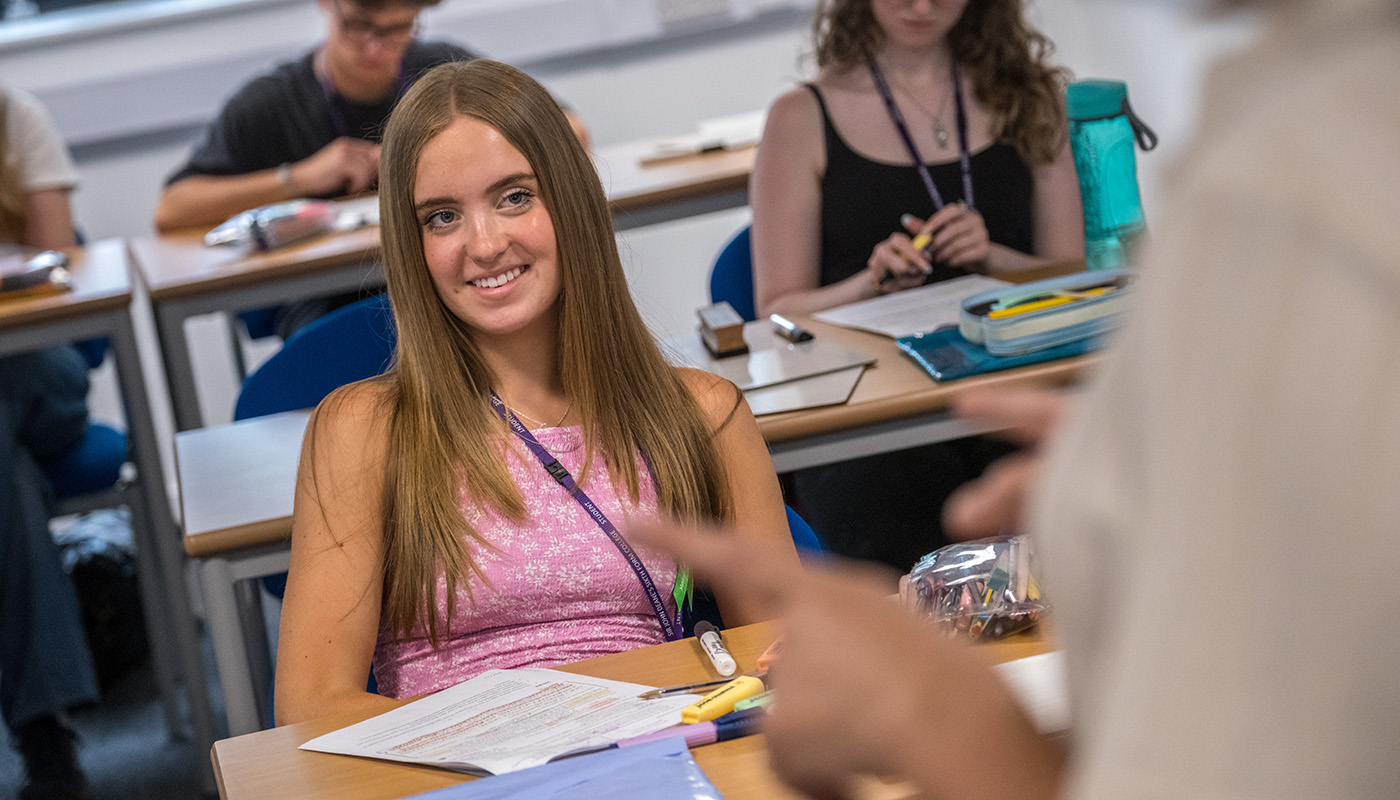
Psychology is a challenging but rewarding course. You will develop skills relating to problem-solving, organisation and initiative that are in demand in the workplace. You will study topics such as responses to people in need, the development of phobias and children’s moral development. You will also focus on a further range of topics including criminal psychology, child psychology and issues in mental health.
Throughout the year we welcome guest speakers to the College that previously have included a cognitive behavioural therapist and a research assistant in forensics. We also run a variety of co-curriculum clubs ad workshops within the department, which this year have included, Psychology and the Courtroom, An Introduction to Astrology and Serial Killer Secrets, allowing students to immerse themselves in the course while engaging in fun debates about real-life phenomenon.
Psychology is a very helpful subject for many possible careers or courses in Higher Education. Whilst it is clearly relevant for careers/courses in the caring professions such as clinical psychology or social work, it is also relevant to many more such as medicine, computer science, scientific and social research, journalism, advertising and market research, nursing, criminology, counselling, management, personnel management, design studies, anthropology, clinical psychology, teaching, pharmacy and biology.
Some of our students have gone on to study Medicine, Dentistry, Physiotherapy or related courses. Psychology can be studied in Higher Education in combination with many other subjects.
Research Methods – Exam Paper (2 hours) – 1/3 of final grade
Psychological themes through core studies – Exam Paper (2 hours) – 1/3 of final grade
Applied Psychology – Exam Paper (2 hours) – 1/3 of final grade
Summary
Research methods
You will become familiar with the four main techniques for collecting and analysing data. These are self-report, experiment, observation and correlation. You will also need to be familiar with planning and conducting research, data recording, analysis and presentation, report writing and science in psychology. You will carry out your own small-scale practical activities and reflect on your experiences.
Psychological themes through core studies
This section will assess your knowledge and understanding of the core studies as well as your ability to evaluate the studies and see them in the context of psychological areas, perspectives and debates. The core studies are placed within a broad area of investigation. Within each area, you are required to examine three core studies, which are focussed around key themes. The 15 selected core studies reflect the contribution of psychology to an understanding of individual, social and cultural diversity.
Applied Psychology
This component is studied in Year 2 of the course and consists of two compulsory sections: Issues in mental health and criminal psychology. You will also study a further applied psychology option which is child psychology. Here, you will learn to apply methodological issues and debates in psychology, recognise the contribution the key research has made to the topic, and apply your knowledge to suggest ways in which improvements can be made to society.
Psychology is a popular subject that can be studied at University on its own or in combination with other subjects. It is useful for many careers (e.g. teaching, police, social work, nursing, personnel). Have a look at the British Psychological Society website for more information about the area of psychology you may be interested in and to find out about different types of psychologists roles. Additionally any reading you can complete around the subject from a standard psychology book will give you a head start on the course. For exam board specific books please contact the psychology department for suggestions.
Study Level
A Level
Exam Board
OCR
Contact Details
Phoebe Rogers
Head of Department
rogers_p@sjd.ac.uk