DANIEL, from Hartford - studying French, German, Maths, Business
"This programme of study has given me the opportunity to learn new skills for the future, and expand on those from high school. The ability to communicate with others through languages internationally is extremely useful, as one of the transferable skills picked up from Maths and Business Studies. Life at the College generally, which tough, is rewarding. The extra-curricular enrichment activities on offer are broad, and there really is something for everyone!"
Photography

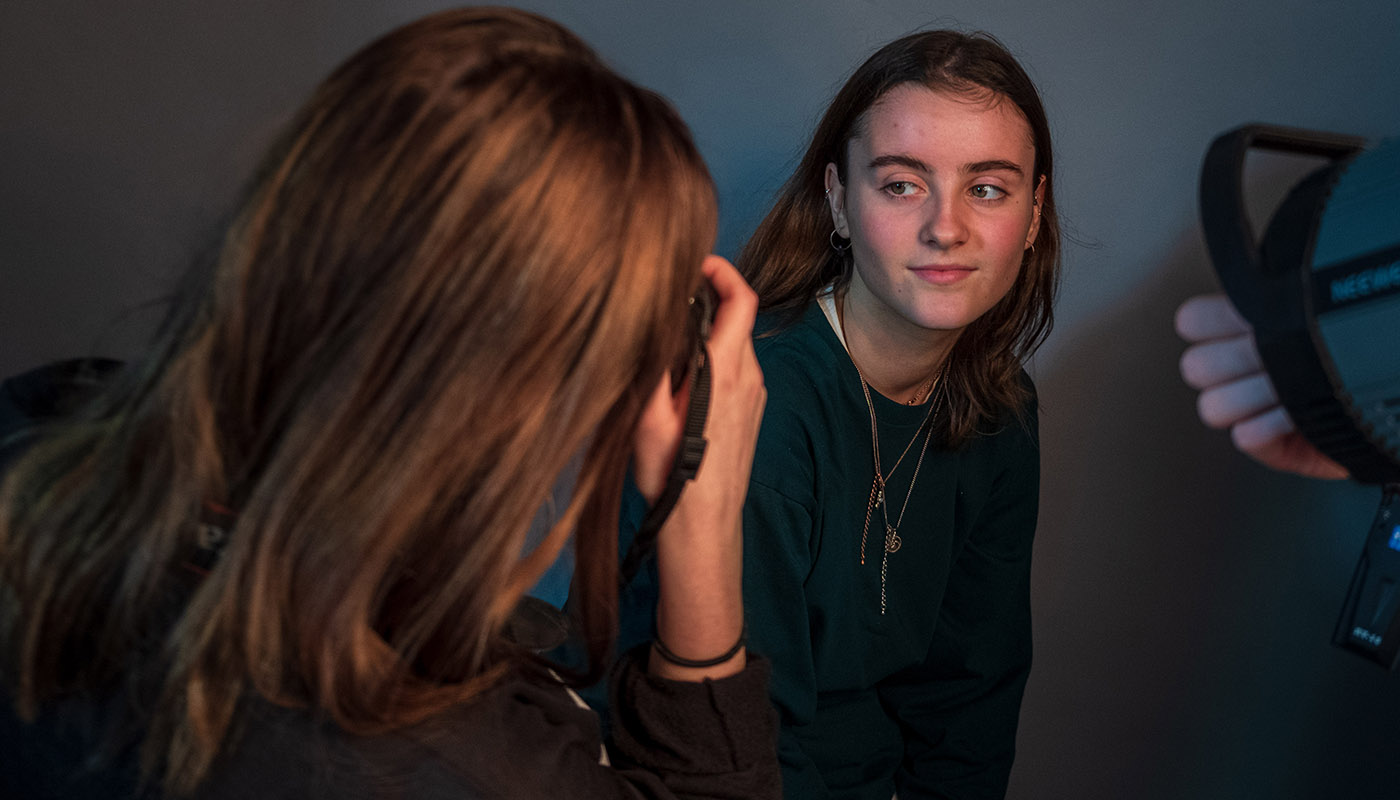
Photography at Sir John Deane’s College is about students and tutors working together in a supportive, dynamic atmosphere exploring a wide range of individual solutions to given problems.
Students should be committed to the subject and happy to be both supported and challenged.
What are the entry requirements?
Students who have achieved grades A to C in Art, Photography, Graphics, Resistant Materials or Textiles at GCSE are ideally suited to cope with the course. We will, however, consider those with a grade D, subject to a portfolio interview. If students wish to take photography without any of the above qualifications, they may be able to apply if they can demonstrate a keen interest and basic proficiency by submitting a series of images based on a mini-brief given at time of application.
What will I study and how will it be assessed?
We follow the AQA specification. The photography course is designed to allow students to be as creative as possible, showing that they can respond to an issue or the boundaries of a brief or theme. You will be taught how to deal with a range of different technical aspects of photography including lighting, depth of field, lenses, and instruction in ‘Photoshop’.
Students will need to be able to demonstrate a sound technical control of the equipment being used in order to facilitate personal ideas. You will be expected to learn how to present your images and ideas carefully and sensitively. You will be responding to a variety of sources for inspiration including ‘The Environment’, ‘Still life’ and ‘Figure / Portrait’.
You will be relying on digital photography and manipulation rather than traditional darkroom practice and wet media. Your studies will certainly lead to a portfolio of printed images but may also have links to a more multimedia approach depending on personal needs. All students will be asked to explore and evaluate the work of other photographers and be able to assess their work in relation to social, environmental and cultural contexts. Linking the critical study element with your creative work is an integral part of the course.
The AS Level is a taught, structured course and emphasis is put on introducing students to ways in which they can utilise the camera to achieve a number of different outcomes, both at the time of shooting and in later manipulation. Relating the work to that of professional artists and developing it through extended research will help you to achieve a successful outcome.
Great emphasis is put upon developing the creative and expressive content of your own artwork as the course proceeds. Workbooks are used to underpin all projects. They will contain developmental ideas, examples of technical experimentation, self review, plus ideas developing from historical and contextual material as well as those that sometimes relate to gallery visits.
Students are required to produce an extended coursework unit, Unit 1 (worth 50% of the overall grade using techniques acquired) and there is an end of course exam, Unit 2 that accounts for the remaining 50%. All work produced on the course becomes part of your portfolio submission.
The A2 course is the natural progression after AS.
In the second year students are expected to work more independently, ideally creating their own starting points and developing the work in the direction they consider most appropriate. Guidance and support is given throughout and work may well be based on experiences and interests developed in the AS course. For this level you will again be required to produce an extended unit of coursework, accompanied by a written and illustrated ‘Journal’ on a subject/artist of your choice.
There is also an extended 15 hour exam at the end of the second unit. Marks are allocated exactly the same as for the AS course: 50% for the Coursework Unit 3 and 50% for the exam, Unit 4. Again all work produced will contribute to your overall portfolio submission.
Does it link well with other subjects?
Photography can be successfully combined with any group of subjects. It is a widely recognised course in terms of Higher Education entry and is accepted as a complementary subject for many degree courses.
Although it requires a lot of course work, Photography coupled with another creative option could also allow for use of interdisciplinary skills.
For example, students doing Photography would be able to use an enhanced photography element on a Fine Art or Media course.
Where might it lead?
Students go to university to study for a degree in any aspect of the photography world including: editorial work, fashion, fine art, forensic, and industrial work.
All of these relate directly to areas of employment. When coupled with another creative option such as Art or Textiles, the options are wide ranging in the creative industries.
Extra-curricular activities and trips?
Students are taken to galleries in the area as well as on location days for Unit One course work. Students are also encouraged to actively seek their own venues and locations for image making.
What materials and equipment are required?
Students will have access to PCs with Photoshop and there are a selection of DSLR cameras, lenses and tripods which we loan out.
We do rely on students generally having their own kit to back this up. Printing out portfolios tends to be the main expense of the course.
Portfolios and memory devices also need to be purchased.
Page top | Page content